
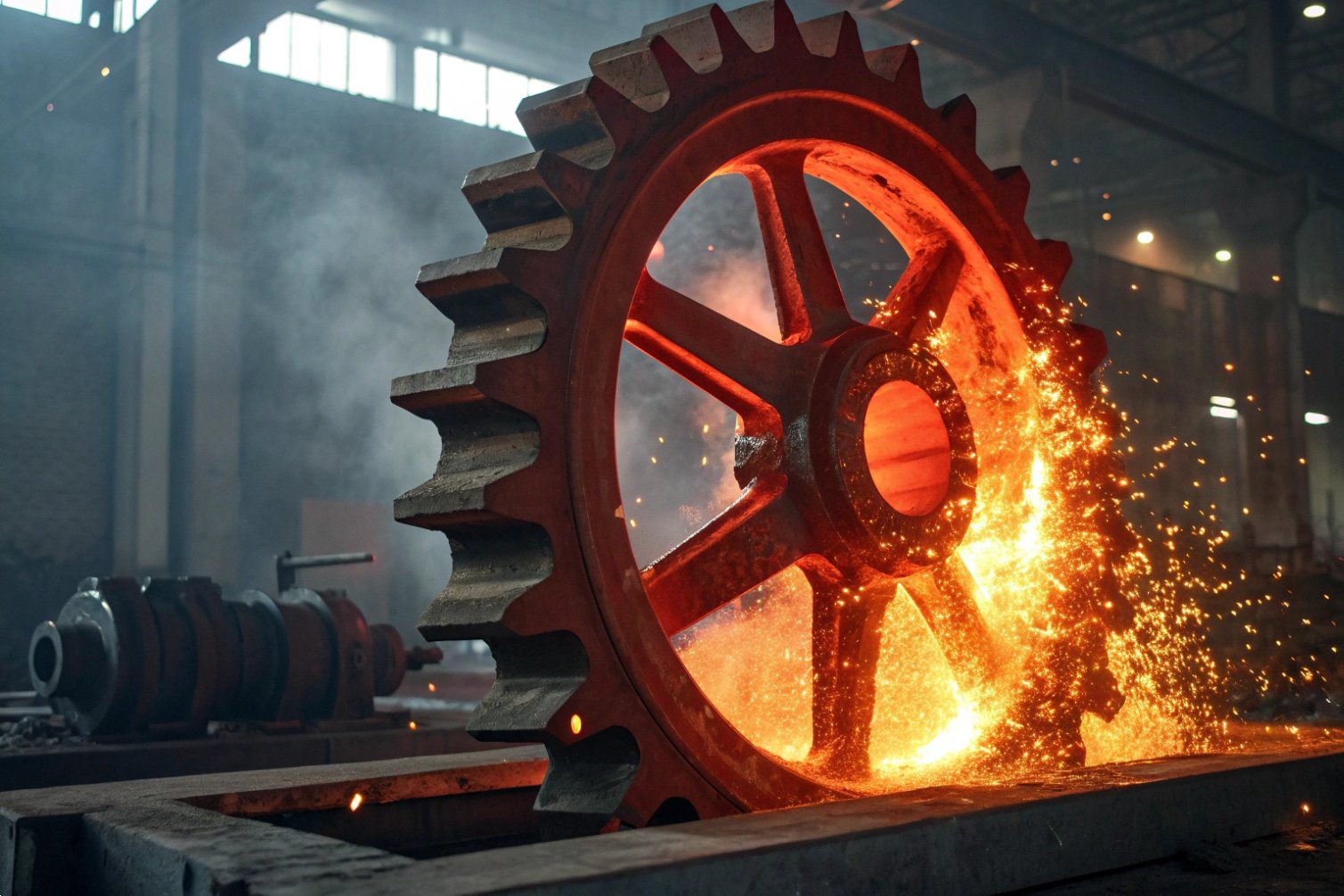
Understanding the specific heat treatment processes 1 used for sprockets and idlers is essential for ensuring their durability and performance. This exploration reveals their critical roles in heavy machinery applications.
Typically, sprockets and idlers undergo processes like induction hardening and through-hardening. These techniques enhance surface wear resistance while maintaining core toughness, essential under demanding conditions.
The variety of heat treatment methods 2 highlights their importance in the performance and longevity of mechanical components, ensuring equipment's reliable and efficient functioning.
Do You Use Induction Hardening or Through-Hardening?
When it comes to heat treatment, the methods of induction hardening 3 and through-hardening are commonly deployed for their distinct advantages.
Induction hardening is used extensively for sprockets to improve surface hardness, while through-hardening is applied to idlers to enhance overall toughness. These techniques ensure that parts resist wear and retain structural integrity under stress.

Induction hardening focuses on selectively hardening areas such as sprocket teeth 4, ensuring a tough exterior capable of resisting significant wear. The core remains ductile, perfect for absorbing impacts without cracking. Through-hardening processes, however, treat the entire component, bestowing a consistent level of hardness throughout 5.
Material Selection and Process Implications
| Method | Application Area | Material Used | Benefit |
|---|---|---|---|
| Induction | Sprockets | Alloy Steel | Surface wear resistance |
| Through-Hardening | Idlers | Carbon Steel | Core strength and toughness |
Frequently employed materials include medium carbon or alloy steels 6 such as 40Mn2 or 42CrMo, known for their favorable heat treatment response. These processes are integral in ensuring that sprockets and idlers meet operational demands.
Quality assurance often involves rigorous testing, including HRC hardness scaling 7, and post-treatment metallographic examination to affirm the uniformity and adequacy of the treatment.
What Is the Target Hardness (HRC) and Case Depth for These Parts?
Ensuring the right hardness and case depth is critical for achieving the desired performance in sprockets and idlers.
Typically, the target hardness for these components ranges from HRC 48-60, depending on the specific requirements, with a case depth varying from 4-8mm. These specifications ensure adequate surface wear resistance and core toughness to withstand operational stresses.
Depth and hardness focus on enhancing resistance to wear and tear. Achieving this involves precise control over heating and cooling cycles 8 during treatment. Surface hardening processes emphasize creating a hard exterior while tempering ensures the component retains its toughness.
Ensuring Ray-Like Consistency
| Component | Target Hardness | Case Depth (mm) | Operational Benefit |
|---|---|---|---|
| Sprockets | 48-60 HRC | 4-8 | Improved wear resistance |
| Idlers | 48-56 HRC | Entire | Enhanced overall durability |
Manufacturers rely on these specifications to confirm that components can endure even the most demanding conditions. Validating such parameters with systematic testing guarantees that parts adhere to required mechanical properties.
How Do You Ensure Uniform Hardness Across the Entire Part?
Uniformity in hardness is crucial in maintaining the reliability of sprockets and idlers 9 throughout their operational life.
Ensuring uniform hardness involves meticulous control during the heat treatment process, including careful heating, precise quenching, and controlled tempering. These measures prevent inconsistencies and ensure performance reliability across the part.

Achieving consistency necessitates a combination of tight temperature controls and strategic process management. The selection of appropriate materials and pre-treatment steps like annealing also play critical roles in reducing internal stresses10, thus minimizing the risk of deformation.
Techniques for Hardness Uniformity
| Control Measure | Objective | Result |
|---|---|---|
| Precise Temperature Control | Prevents hotspots and brittleness | Consistent hardness throughout part |
| Annealing | Reduces internal stress | Stabilizes material structure |
| Consistent Process Timing | Ensures even treatment application | Homogenous material properties |
These techniques help mitigate variations and guarantee consistent mechanical performance, avoiding issues like uneven wear or localized weaknesses.
Can I Get the Heat Treatment Specifications for These Parts?
Understanding the heat treatment specifications is key for evaluating the quality and longevity of machinery components.
Yes, detailed heat treatment specifications are typically provided with components, covering aspects like hardness levels, treatment duration, and temperature profiles. This transparency allows for informed comparisons and ensures alignment with specific operational needs.

Proper documentation often comprises detailed material tests, treatment parameters, and outcome validations like hardness tests. These documents also include response data to ensure transparency in the supply chain and facilitate rigorous quality control.
Importance of Detailed Specifications
| Specification Aspect | Insight Provided | Importance |
|---|---|---|
| Hardness Tests | Confirms mechanical properties | Validates component durability |
| Treatment Profiles | Details process temperatures and times | Allows for process replication |
| Material Certifications | Certifies metal quality and compliance | Ensures compatibility and safety |
Having access to comprehensive specifications assures customers of the quality and expected performance, supporting strategic decision-making and fostering trust in supplier relationships.
Conclusion
Heat treatment processes, when well-managed and documented, are pivotal in enhancing the performance, durability, and reliability of sprockets and idlers, ensuring they meet the rigorous demands of heavy machinery operations.
Footnotes
1. Explore an in-depth overview of the science and application of heat treatment processes. ↩︎
2. Comprehensive guide detailing various methods of heat treatment and their distinct industrial uses. ↩︎
3. Learn about the principles and advantages of induction hardening technology for metal parts. ↩︎
4. Resource explaining the design and function of different types of sprocket teeth and their wear characteristics. ↩︎
5. Academic explanation of through-hardening and its effect on achieving uniform strength in metal components. ↩︎
6. Detailed comparison of carbon and alloy steels and their suitability for high-performance mechanical parts. ↩︎
7. Official information on the Rockwell C (HRC) hardness scale testing method used for quality control. ↩︎
8. Educational material on how precise heating and cooling cycles are critical for material structure. ↩︎
9. Industry analysis focusing on the factors that determine the performance and lifespan of chain drive components. ↩︎
10. Explanation of what internal stresses are and how different processes help to mitigate them in materials. ↩︎