

Sourcing parts from China 1 can feel complex. You worry about who will handle your order. You just want one reliable person who understands you.
As a manufacturer with over 20 years in this business, I know your main contact is critical. You will almost always work with a dedicated export manager or senior salesperson who coordinates everything for you.
But that single point of contact is just the start. The real question is how that person handles technical details, logistics, and unexpected problems. How do you know if you have a true partner or just a message-taker?
Let's break down how a good supplier (like us) manages this relationship, and what you should demand from your contact.
Will my contact (like Linda) be able to answer my technical questions?
You have a specific question about material. You dread asking your salesperson. You fear they won't understand heat treatment 2 or OEM part numbers 3.
In my experience, a great export manager must answer your technical questions. I personally train my team to understand our undercarriage parts—from material composition and hardness to OEM compatibility—so you get clear answers fast.
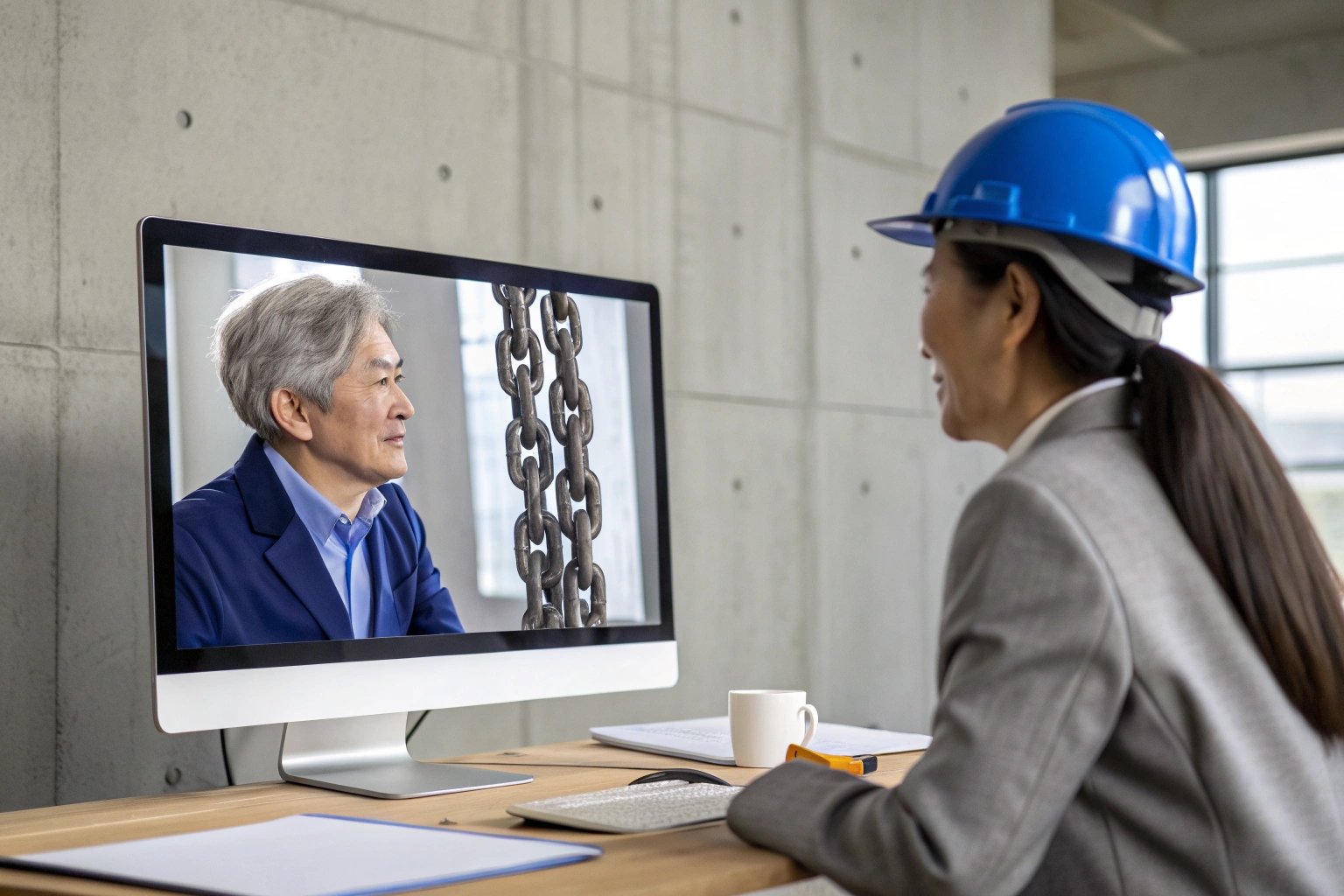
When you are buying complex, heavy-duty components like track rollers 4 or sprockets, the technical details are not just details; they are the entire product. A contact who cannot discuss these details is a major red flag.
This is a common pain point I hear from clients like "David," a purchasing director in the US. He used to work with trading companies where the salesperson was just a middleman. They would "ask the engineer" for every small question, creating delays and confusion.
The "Manufacturer's Rep" vs. The "Trader"
There is a huge difference between a salesperson at a trading company and an export manager at a true manufacturer.
- A Trader's Salesperson: Their job is to find a product at the lowest price. They often know very little about the engineering, the materials, or the quality control (QC) process 5. They are a "relay."
- A Manufacturer's Export Manager (Like my team): Our job is to represent the factory. We walk the factory floor every day. We talk to the engineers and the QC team. We must understand the product to sell it.
A good contact should be your first line of technical support. They should be able to discuss:
- Material Specifications 6: What steel are you using? (e.g., 40MnB or 50Mn for a track chain).
- Heat Treatment: What is the case depth and surface hardness (HRC)?
- OEM Compatibility: Will this part (e.g., a Dingtai roller) fit a Komatsu PC200-8?
- Warranty Details: What failures are covered, and for how long?
How We Handle Technical Questions
At Dingtai, our export team is trained to handle 90% of technical questions on the spot. We have a shared database with all specifications, drawings, and compatibility lists.
When you ask us, "Is this roller compatible with a Cat D9?" we don't just say "yes." We say, "Yes, it is fully compatible. It uses [Material Spec], has a surface hardness of [HRC 52-58], and we have it in stock. Here is the spec sheet."
This approach saves you time and builds confidence. You know you are speaking with someone who understands the product.
Table: Manufacturer vs. Trader Contact
| Feature | Manufacturer Rep (e.g., Dingtai) | Trading Company Sales |
|---|---|---|
| Product Knowledge | Deep. Understands materials, C, and specs. | Shallow. Knows part numbers, not engineering. |
| Answer Speed | Fast. Can answer most questions immediately. | Slow. Must "ask the engineer" for simple questions. |
| Problem Solving | Can discuss solutions. | Can only relay messages. |
| Main Goal | Build long-term relationship based on quality. | Make a single sale based on price. |
If I have a technical problem, will I be transferred to an engineer?
You have a complex issue. A part failed in the field, or a custom drawing has a problem. Your salesperson is stuck. You need a real expert now.
Yes, absolutely. If a problem is highly complex, I make sure you are connected directly with our engineering team. We don't hide our experts; we use them to solve your problems quickly and build trust.

This is about efficiency. Your time is valuable. My engineers' time is valuable. We don't want a "telephone game" where your technical questions get lost in translation by a non-technical salesperson.
A professional supplier should have a clear escalation path. For a client like David, who has deep technical experience himself, speaking with another expert is essential. He needs to know that his supplier respects his knowledge.
Our Two-Tier Support System
Think of it this way: your main contact (your Account Manager) is your "Tier 1" support. They are your champion inside our company. But for deep, specialized issues, we bring in "Tier 2."
-
Tier 1: Your Account Manager (Your Main Contact)
- Handles 90% of all communication.
- Pricing, quotes, and contracts.
- Logistics and shipping updates.
- Standard technical questions (compatibility, specs).
- Basic after-sales issues.
-
Tier 2: The Engineering Team (Direct Access)
- Called in by your Account Manager.
- Handles highly complex issues.
- Examples: Analyzing a field failure report, discussing custom design blueprints (OEM), or developing a part for a unique, high-abrasion environment.
Why Direct Engineer Access Is Better
When a complex problem arises, the worst thing is delay. If you have a machine down, you need answers.
By connecting you directly with our engineers (in a scheduled call or email chain managed by your Account Manager), we:
- Eliminate Miscommunication: Your technical expert talks to our technical expert.
- Speed Up Solutions: We get to the root cause faster.
- Show Transparency: We have nothing to hide. We are proud of our technical team and want you to meet them.
This structure gives you the best of both worlds: a single, dedicated contact for daily business, and an "on-demand" team of experts for critical issues.
Table: Who to Contact for What?
| Type of Inquiry | Your Account Manager (Tier 1) | Our Engineer (Tier 2) |
|---|---|---|
| Price Quote | Yes | No |
| Shipping Status | Yes | No |
| Part Compatibility | Yes | As needed |
| Custom Part Design | Manages | Leads |
| Failure Analysis | Manages | Leads |
| Warranty Claim | Yes | As needed |
Who do I contact for logistics and shipping updates for my order?
Your container is late. You need to know where it is. You don't know who to call. Your production line or your customer is waiting.
You should have one person for all updates. I make sure my team manages the entire process. This means your single contact gives you clear, proactive updates on production, inspection, and shipping.

This is one of the biggest fears in global trade: the "black hole" of information. You place an order, send money, and then... silence. This is not acceptable.
A key pain point for importers is being passed around. The salesperson says, "That's a logistics question. Talk to our shipping department." The shipping department is in a different time zone and doesn't speak English well. This is a nightmare.
Our "Single Point of Truth" Model
Your Account Manager is your "single point of truth." They are responsible for your order from the moment you sign the P.I. (Proforma Invoice 7) to the moment it arrives at your port.
They do this by having access to our internal systems:
- ERP (Enterprise Resource Planning) 8: They can see your order status in real-time. Is it in casting? Is it in heat treatment? Is it in final assembly?
- QC Reports: They receive the 100% final inspection report from our QC department before it's packed.
- Logistics Updates: They work with our logistics team to get vessel names, ETD (Estimated Time of Departure), and ETA (Estimated Time of Arrival).
Proactive Communication is Key
You shouldn't have to ask for an update. We provide updates proactively at key milestones. This is what you should expect:
- Milestone 1: Order Confirmed. Production scheduled.
- Milestone 2: Production Complete. Final QC photos and report sent.
- Milestone 3: Container Booked. We send you the vessel name, ETD, and ETA.
- Milestone 4: Container Loaded. We send you loading photos and a draft Bill of Lading (B/L) 9.
- Milestone 5: Vessel Sails. We send you the final tracking documents.
This process eliminates anxiety. Even if there is a delay (like a port closure or typhoon), we tell you immediately. We also understand time zones. My team is trained to respond to all inquiries within 24 hours, guaranteed.
Do I get a dedicated account manager for all my needs?
You are tired of re-explaining your company's needs every time you call. You are a serious distributor, not a one-time buyer. You want someone who knows your business.
Yes, for strategic partners and long-term customers, I absolutely provide a dedicated account manager. This person, often myself or a senior rep, understands your history, your market, and your goals.

This is the ultimate solution. A dedicated account manager is not just a salesperson. They are your strategic partner inside the factory.
This directly addresses the fear of chaotic contacts. For a customer like David, who buys in volume and needs a stable supply chain 10, a "transactional" salesperson is useless. He needs a relationship manager.
Salesperson vs. Account Manager
- A Salesperson is focused on the next order.
- An Account Manager is focused on your next three years.
This manager is your internal advocate. They fight for your production priority. They understand your specific requirements (e.g., you need special anti-rust oil, or you prefer pallets to be stacked a certain way).
What About Staff Changes?
Another valid fear is staff turnover. What if your great contact leaves the company?
This is a management problem. At Dingtai, we solve this in two ways:
- Strong Systems (CRM): All your order history, technical requirements, and past conversations are stored in our central system. If a new manager takes over, they are not starting from zero.
- Warm Handovers: We don't just "pass you" to someone new. I personally manage the transition. The old manager, the new manager, and I will have a meeting. We review your entire history. Then, we introduce the new manager to you. The transition is seamless.
Your business is too important to be lost in a filing cabinet. A professional supplier invests in systems and people to ensure continuity.
Table: Benefits of a Dedicated Account Manager
| Area | What They Do | Your Benefit (Why it Matters) |
|---|---|---|
| Commercial | Manages pricing, contracts, and forecasts. | Stable pricing and supply. No surprises. |
| Technical | Knows your product list and technical needs. | Faster quotes, correct parts, no re-explaining. |
| Logistics | Proactively manages your shipments. | You can plan your inventory and cash flow. |
| After-Sales | Handles all warranty claims personally. | Fast, no-hassle resolution to problems. |
| Strategic | Understands your market and helps you grow. | A true partner, not just a parts supplier. |
Conclusion
Finding the right contact is key to successfully importing from China. Look for a supplier who gives you a technically-skilled, dedicated manager. This person is your bridge to the factory and your partner for growth.
Footnotes
1. A guide on the process of sourcing industrial parts from Chinese suppliers. ↩︎
2. Learn about the heat treatment process and how it strengthens steel undercarriage parts. ↩︎
3. Explanation of Original Equipment Manufacturer (OEM) part numbers and their role in compatibility. ↩︎
4. Discover the function and types of track rollers in heavy machinery undercarriages. ↩︎
5. An overview of the standard quality control (QC) process used in manufacturing. ↩︎
6. Understand what material specifications are and why they are critical in engineering. ↩︎
7. Definition and purpose of a Proforma Invoice in international trade and sales. ↩︎
8. Learn what Enterprise Resource Planning (ERP) software is and how manufacturers use it. ↩︎
9. An essential guide to the Bill of Lading (B/L) and its function in shipping. ↩︎
10. Strategies and best practices for building a resilient and stable supply chain. ↩︎