
I have seen many suppliers online, but I never want to pay trading company markups by mistake. This is my first check before any purchase.
You can confirm if your supplier is a real manufacturer by asking for their business license, ISO certificates, and proof of production facilities. You can also schedule a factory visit or have a third-party audit to see the production lines yourself. Matching addresses, consistent documents, and direct technical answers are clear signs you are dealing with the factory.
If you stop reading now, you might still fall for a trading company’s trap. Keep going to see how I verify them step by step.
Can I schedule a factory tour or a third-party audit of your facility?
I always trust what I can see with my own eyes. Factory tours tell me more than any sales pitch ever could.
Yes. You can schedule a visit to the factory or hire an independent inspection firm to audit the facility. Both options allow you to confirm the machinery, production lines, and staff that belong to the manufacturer. This gives you hard proof before placing your order.

Why factory visits work
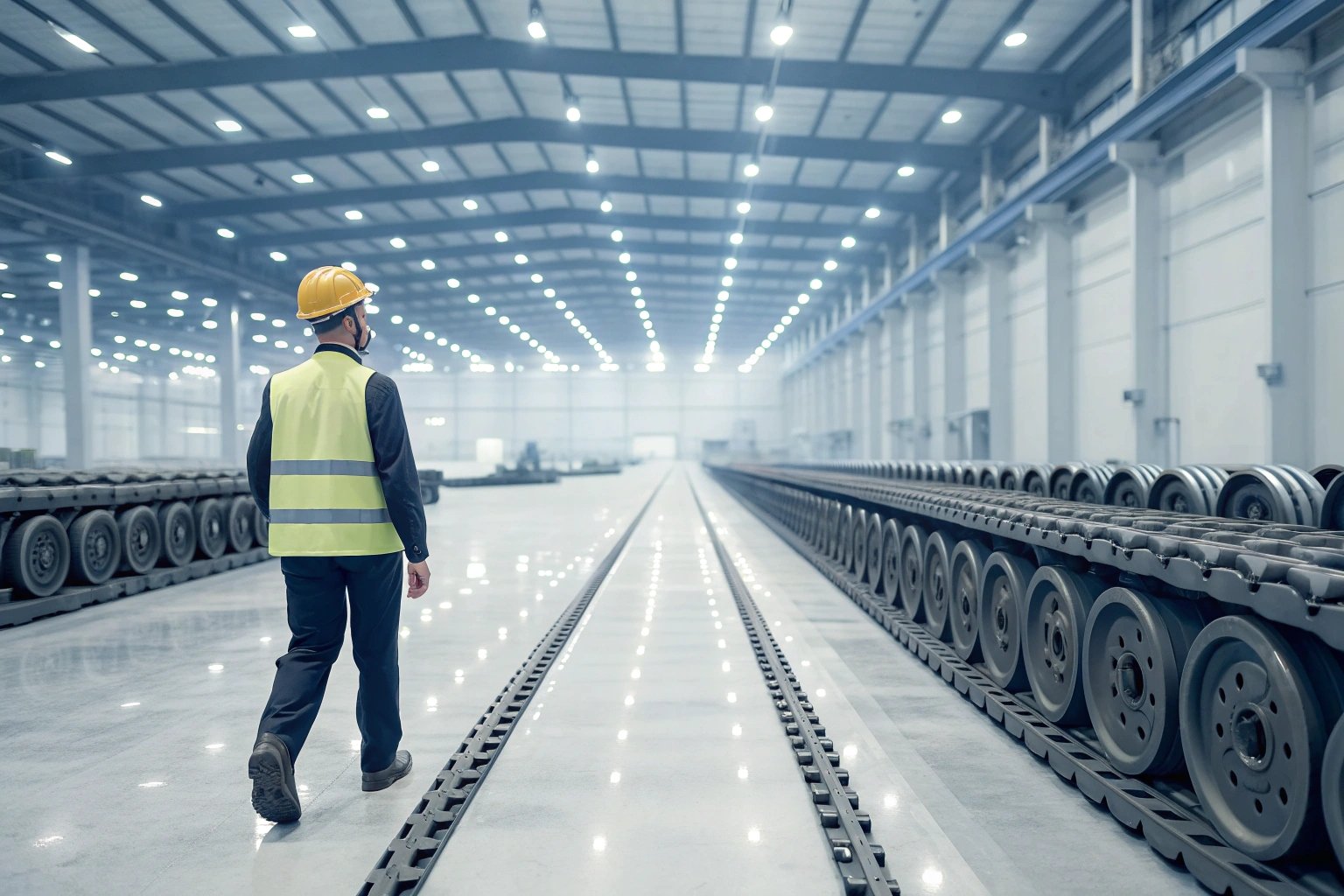
When I visit a production site, I see the welding stations, CNC machines, and assembly lines. Trading companies cannot pretend to have this setup. I ask to walk through each part of the process. I watch raw steel become track rollers 1, and I see heat treatment in action 2. I ask about production capacity3, because real manufacturers know their numbers .
Table: Factory Visit Checklist
| Checkpoint | What to Look For | Why It Matters |
|---|---|---|
| Machinery | Heavy machining & testing equipment | Confirms in-house production |
| Staff | Workers in uniforms & safety gear | Shows operating production lines |
| Raw Materials | Storage of steel, rubber, etc. | Indicates actual manufacturing |
| Quality Control Station | Measuring tools & inspection booths | Confirms QA process |
I always note the factory’s exact location and compare it to their business license 4. I check if the staff know detailed specs of my required parts. A trading company’s sales rep often cannot answer complex technical questions5 without hesitating or consulting someone else .
A third-party audit6 adds another layer of security . The inspection company takes photos, videos, and measures output capacity. They usually give a report with evidence that helps me decide.
Can you provide documentation (like ISO 9001 cert or business registration) proving you are the manufacturer?
When money is on the line, paperwork tells the truth. Documents cannot be easily faked without risk.
Yes. Manufacturers can show ISO 9001, SGS reports, and official business licenses. The name and address on these must match the branding, invoices, and contracts. Certifications prove compliance with standards, and business registration proves legal factory ownership.

How to cross-check documents
I check the date of certification. If I see an ISO 9001 certificate 7 valid for the past three years, it shows ongoing quality control. I match the company name across the license, invoices, and website domain. I search trademark databases8 to confirm the brand belongs to them .
Table: Key Manufacturer Documents
| Document | Purpose | Verification Step |
|---|---|---|
| Business License | Confirms legal entity | Match address with factory location |
| ISO 9001 Certificate | Shows quality system compliance | Verify through issuing body’s website |
| Trademark Registration | Confirms ownership of brand | Search official trademark database |
| SGS / Third-Party Test | Independent quality confirmation | Review report number and validity |
I also use online maps to check the address. If it sits in an industrial zone with visible production buildings, it is more believable. If it is in a high-rise office block downtown, it might be a trading desk.
Do you manufacture 100% of the parts (e.g., track rollers, idlers) in-house?
I want to know the origin of every part. Outsourced production9 often means inconsistent quality .
Yes. In-house manufacturing means all main parts like track rollers, idlers, sprockets, and track chains are produced under the same roof. This ensures uniform quality control and matching material specifications across batches.

Why in-house is better
When all parts come from the same plant, the heat treatment is consistent. The steel composition matches the tolerance requirements of my machines. If the same team handles casting, machining, and finishing, I get parts that fit perfectly every time.
Table: In-House vs Outsourced Production
| Factor | In-House Manufacturing | Outsourced Production |
|---|---|---|
| Quality Control | Direct oversight | Varies by external supplier |
| Lead Time | Faster and predictable | Dependent on third-party schedules |
| Customization | Flexible adjustments possible | Limited to supplier’s capability |
| Compatibility | Matches OEM specs | Risk of mismatch |
Tracking each part through the production line gives me peace of mind. I can see the forging process for sprockets, the precision turning for idler assemblies, and the hardening process for roller shells. All these stages happen under one management system.
What advantages do I get by buying direct from your factory?
Middlemen add cost and slow down problem solving. I value speed and clarity.
Buying directly from a factory means lower prices, faster communication, better customization, and stronger after-sales support. You skip trading company markups and gain faster access to technical staff who know the production details.

Clear benefits of buying direct
Lower prices come from removing trading margins 10. Communication is faster because I speak to engineers, not brokers. I can request changes in dimensions or materials to suit my worksite conditions. If there is a problem, the factory’s after-sales team responds with replacement parts quickly.
I also gain supply chain transparency. The manufacturer tells me the source of raw materials, the production schedule, and the lead time. This information helps my project planning and reduces downtime.
Buying direct strengthens long-term relationships. Once a manufacturer knows my equipment fleet, they produce parts optimized for my needs. This also leads to better payment terms and secure pricing for future orders.
Conclusion
Direct factory sourcing saves costs, ensures quality, and prevents supply chain risks. It is the safest way to buy bulldozer undercarriage parts.
Footnotes
1. See a detailed guide on the process of manufacturing quality track rollers. ↩︎
2. Learn about the different types and importance of metal heat treatment in parts production. ↩︎
3. Understanding how manufacturers calculate and manage their production capacity for large orders. ↩︎
4. Guide to verifying a company's legal status and operational history using public business licenses. ↩︎
5. Insights into the necessity of direct technical expertise when sourcing specialized machinery parts. ↩︎
6. Explanation of how independent third-party audits verify a manufacturer's claims and capabilities. ↩︎
7. Explore the requirements and benefits of maintaining ISO 9001 for quality management systems in manufacturing. ↩︎
8. Tips on using international trademark databases to confirm true brand ownership and combat counterfeiting. ↩︎
9. A review of the potential quality and consistency risks associated with heavily outsourced production models. ↩︎
10. Analysis of how eliminating trading company markups leads to significant cost savings in procurement. ↩︎