What is the complete list of documents I need to clear US customs for undercarriage parts for excavators?

  Mechanical part with documents, notebook, and pen on engineering desk.

Importing parts seems complex. Worried your container will get stuck at US customs? I've sent countless shipments. Let's walk through the exact list you need for a smooth clearance.

From my experience shipping to clients, the complete list is essential. You absolutely need the Bill of Lading, Commercial Invoice, and Packing List. You also need the ISF filing (for ocean), a Customs Bond, and the Entry Summary (CBP 7501).

Having that main list is the first step. But many of my clients, especially experienced ones, ask about the details. They want to know why each document matters and who is supposed to handle it. Getting this wrong causes expensive delays. Let's break down each part of the process.

Do I always need the Commercial Invoice, Packing List, and Bill of Lading?

You see these three documents on every shipment. Do you ever wonder if they are really all necessary? From my side as the manufacturer, these three are the absolute core of the trade.

Yes, in my 20 years of exporting, you always need all three: the Commercial Invoice, the Packing List, and the Bill of Lading (or Airway Bill). I see these as the 'Big Three.' They are the minimum requirement for any international shipment to the US.

Laptop and calipers with architectural plans on wooden desk.

These three documents form the base of your import declaration. US Customs and Border Protection (CBP) 1 uses them to answer three basic questions: What did you buy? How is it packed? And who owns it?

If you get these wrong, nothing else matters. The shipment will stop.

The "Big Three" Explained

Each document has a specific job. You cannot combine them.

  • 1. Commercial Invoice (CI): This is the bill of sale. It tells CBP the financial details of your transaction. It must be accurate. I often see new importers ask if we can declare a lower value to save on duties. This is a huge mistake. US Customs knows the value of undercarriage parts. A false invoice leads to fines, penalties, and future inspections. The invoice must list the buyer, seller, product descriptions, HTS codes 2, value, and origin.
  • 2. Packing List (PL): This document details how the goods are packaged. It must match the Commercial Invoice. If the invoice says 100 track rollers, the packing list must show which crates contain those 100 rollers. It lists weights (net and gross) and dimensions. CBP uses this for physical inspections. If your packing list is unclear, they may order a full container destuffing, which costs you time and money.
  • 3. Bill of Lading (B/L) or Airway Bill (AWB): This is the most important document. It is the title of ownership. For ocean freight, the Bill of Lading (B/L) 3 is issued by the shipping line. It proves we (the supplier) have given the cargo to the carrier. You (the buyer) need this document to claim the goods at the port. It must match the CI and PL exactly.

Why Details Matter on These Core Documents

My most experienced customers check these documents carefully before the ship sails. A small typo can cause big problems. A wrong address or a misspelled name can halt the entire process.

Here is a checklist I use to verify these documents for my clients:

Document Key Information to Verify Common Mistake to Avoid
Commercial Invoice Buyer/Seller names, HTS code, value per item, total value, currency. Undervaluing the goods. This is illegal and high-risk.
Packing List Gross/Net weights, dimensions, package contents. Must match CI. Vague descriptions like "excavator parts." Be specific (e.g., "D8 Track Rollers").
Bill of Lading Shipper/Consignee names, port of loading/discharge, container number. Consignee name mismatch. It must match the importer of record.

We, as your manufacturer, prepare the Commercial Invoice and Packing List. The freight forwarder or shipping line issues the Bill of Lading based on our information. Always demand drafts of these documents from your supplier before the vessel departs.

What other documents, like a certificate of origin, might be required?

You have the main three documents. But then your broker asks for forms you've never heard of. It can be confusing. I've learned these US-specific forms are mandatory for a smooth entry.

Beyond the Big Three, I've found US importers always need an Importer Security Filing (ISF) for ocean freight. You also must have a Customs Bond. Depending on the parts, you might need a Certificate of Origin (C/O) or specific anti-dumping documents.

Men with blurred faces discussing container logistics in outdoor facility.

This is where importing into the US gets specific. These documents are not always provided by the seller. They relate to US security, tax collection, and trade policy.

US-Specific Entry Requirements

These are mandatory for importing into the United States.

  • Importer Security Filing (ISF 10+2): This is only for ocean freight. It is a security measure. It must be filed before the cargo is loaded onto the ship in China. It tells CBP who is shipping what, where it's going, and who is receiving it. Failure to file this on time results in a $5,000 penalty.
  • Customs Bond: You cannot import commercially into the US without one. This is an insurance policy with CBP. It guarantees that all duties and fees will be paid. You can buy a "Single Entry Bond" for one shipment or a "Continuous Bond" if you import regularly. Most of my long-term partners use a Continuous Bond 4.
  • Entry Summary (CBP Form 7501): This is the formal declaration. Your customs broker files this form. It lists the HTS codes, value, origin, and duties owed. This is where all the other documents (CI, PL, B/L) come together.

Conditional or "As-Needed" Documents

These documents depend on the product and current trade laws.

  • Certificate of Origin (C/O): This document certifies that the goods (your undercarriage parts) were manufactured in China. Why do you need it? It's crucial for tariff rates. Sometimes, the US has trade agreements or, conversely, imposes tariffs (like Section 301 tariffs 5) based on the country of origin. We can provide this from our end.
  • Anti-Dumping/Countervailing Duty (AD/CVD) Documents: This is very important. Certain products from certain countries are subject to extra duties. Your customs broker must check if your specific HTS code for track links or rollers is subject to AD/CVD 6. If it is, special paperwork is needed.
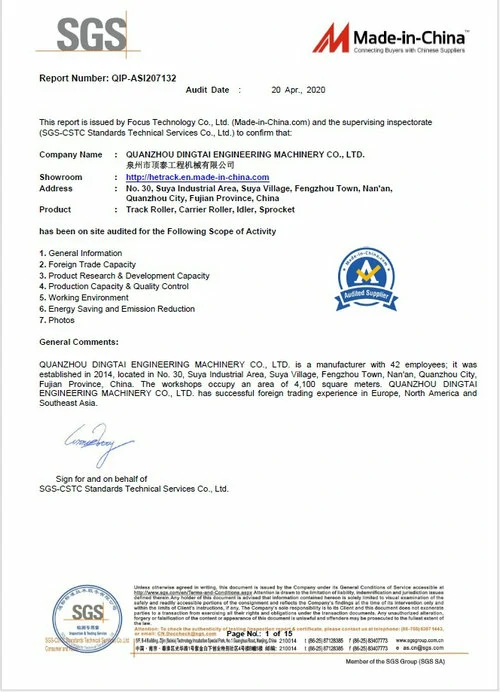
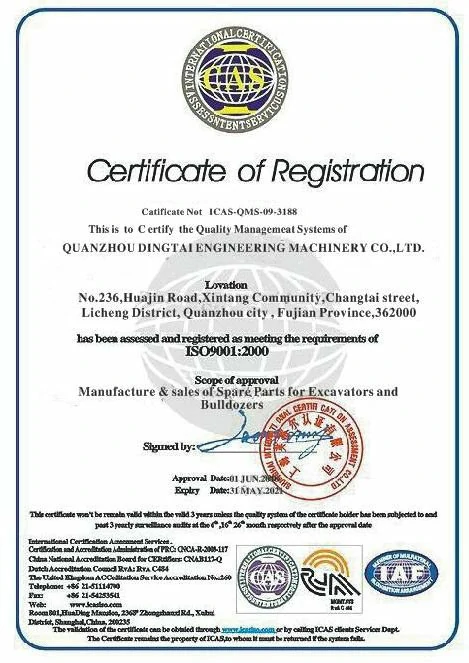
  • Product Compliance Certificates: For some parts, you might need to show they meet US standards (like safety or materials). While less common for simple undercarriage, it's good to ask us, your manufacturer, for our ISO9001 7 or SGS reports as proof of quality.

Here is a breakdown of common HTS (Harmonized Tariff Schedule) codes for our products. Getting this code right is critical for duties.

Product Example Potential HTS Code Importance
Track Chains (Links) 8431.49.90 Determines the base duty rate.
Track Rollers 8431.49.90 Must be classified correctly.
Drive Sprockets 8431.49.90 Check this code for AD/CVD flags.

You must verify these codes with a licensed customs broker.

Who is responsible for preparing these documents – me, my supplier, or my freight forwarder?

You now have a long list of documents. It's confusing to know who does what. You don't want to be stuck doing someone else's job. I make this clear for my clients.

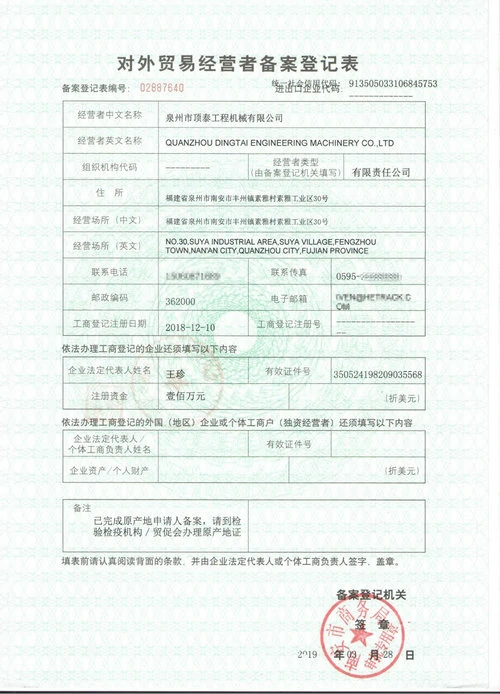
I've learned that responsibility is shared. As your supplier, I (Dingtai) prepare the Commercial Invoice, Packing List, and Certificate of Origin. Your freight forwarder handles the Bill of Lading and ISF. You (the importer) are responsible for the Customs Bond and final entry.

Illustrated supply chain management scene with people and containers.

A smooth customs clearance is a partnership. Everyone has a specific role. When I work with experienced buyers, the process is very clear. Here is how the responsibilities are divided.

The Supplier's Role (Our Role)

We, the manufacturer (Dingtai), are responsible for all documents related to the goods themselves.

  • Commercial Invoice: We create this. It's our bill to you.
  • Packing List: We create this. We are the ones packing the crates.
  • Certificate of Origin: We apply for this with the local authorities in China.
  • Product Certifications (ISO/SGS): We provide copies of our quality reports.

Our job is to ensure these documents are 100% accurate. We send them to you and your forwarder before the ship sails. This proactive step is crucial.

The Freight Forwarder / Customs Broker's Role

Your forwarder (or customs broker 8) handles the logistics and declaration.

  • Bill of Lading (B/L): The shipping line (carrier) issues this, but your forwarder coordinates it.
  • Importer Security Filing (ISF): Your forwarder or broker must file this. They will need the B/L, CI, and PL data from us to do it.
  • Customs Entry (CBP 7501): Your customs broker in the US files this. They are the licensed expert who submits all the paperwork to CBP on your behalf.

The Importer's Role (Your Role)

As the buyer (Importer of Record), you hold the ultimate responsibility and liability.

  • Hiring Experts: You are responsible for hiring a reliable customs broker and freight forwarder.
  • Customs Bond: You must purchase and have a valid customs bond.
  • Importer ID: You must provide your Importer ID number (often your IRS EIN).
  • Accuracy: You are ultimately responsible for ensuring all information submitted by your supplier and broker is true and correct.
  • Payment: You are responsible for paying all duties and taxes.

This table breaks down the responsibility for the most common documents:

Document Prepared By (Typical)
Commercial Invoice Supplier (Dingtai)
Packing List Supplier (Dingtai)
Certificate of Origin 9 Supplier (Dingtai)
Bill of Lading (B/L) Freight Forwarder / Shipping Line
Importer Security Filing (ISF) Freight Forwarder / Broker
Customs Bond Importer (You)
Entry Summary (CBP 7501) Customs Broker

This division of labor is why I value long-term partners. When the supplier, forwarder, and importer trust each other, the process is fast and seamless.

What happens if my documents are missing or contain incorrect information?

It's easy to make a small mistake on a form. You might think it doesn't matter. But I have seen small mistakes cause huge, expensive delays for my clients.

In my experience, missing or incorrect documents lead to disaster. Your shipment will be held by CBP. You will face expensive daily fees called 'demurrage.' You may also be fined, and your cargo will be flagged for 100% inspection on all future shipments.

Blurred workers at a shipping port during twilight hours.

This is the biggest pain point I hear from new clients. They often come to us after a nightmare shipment with an unreliable supplier. Problems with documents are not small problems. They are expensive, stressful, and damage your reputation.

The Cascade of Problems

When CBP finds an error, a chain reaction starts.

1.  The Hold: Your container is flagged and put on hold. It cannot leave the port.
2.  The Fees Start: The port terminal gives you a few free days. After that, you are charged "demurrage." 10 This is a daily storage fee that can be $100 to $300+ per day, per container.
3.  The Inspection: CBP will likely order an exam. This could be a simple X-ray or a full "intensive exam," where they unload the entire container to count the parts. You pay for this exam, which can cost thousands.
4.  The Fines: If you failed to file ISF on time, that's a $5,000 fine. If you undervalued the goods, the penalty can be a percentage of the entire shipment's value.
5.  The Delay: The entire process can take weeks. Your track rollers and sprockets are sitting at the port, not in your warehouse. Your customers are angry, and you lose sales.

Common Errors We Work to Prevent

I train my technical sales team to be experts in documentation, not just parts. We actively prevent the errors that cause these disasters.

  • Mismatching Information: This is the number one problem. The CI says 50 crates, but the B/L says 49. Or the weight on the PL is different from the B/L. This is an immediate red flag for CBP. We double-check all documents against each other.
  • Vague Descriptions: A CI that just says "Machine Parts" is not acceptable. We list "Excavator Track Link Assembly, P/N 123-456." This matches the HTS code and helps CBP understand what is inside.
  • Late ISF Filing: This is an easy mistake. The forwarder must file before loading. We send our document drafts to the forwarder 72 hours before the cut-off to ensure they have time.

This is why working with an experienced manufacturer is so important. A cheap price on a part means nothing if you pay $10,000 in port fees because the supplier saved five minutes on paperwork. My team and I protect your shipment from start to finish.

Conclusion

Clearing US customs is about teamwork and accuracy. The "Big Three" (CI, PL, B/L) plus US-forms (ISF, Bond) are essential. We ensure our paperwork is perfect to prevent any delays.


Footnotes  

1. Official website for U.S. Customs and Border Protection (CBP). ↩︎  
2. Official U.S. Harmonized Tariff Schedule (HTS) lookup tool. ↩︎  
3. Investopedia explains the legal role of a Bill of Lading in shipping. ↩︎  
4. CBP official guide explaining Customs Bonds for importing. ↩︎  
5. U.S. Trade Representative page on Section 301 tariffs. ↩︎  
6. Learn about Anti-Dumping and Countervailing Duties (AD/CVD) from Trade.gov. ↩︎  
7. Details on the ISO 9001 quality management standards. ↩︎  
8. CBP information on the role and responsibilities of a customs broker. ↩︎s  
9. U.S. Dept. of Commerce guide on Certificates of Origin. ↩︎  
10. A logistics guide explaining what demurrage fees are in shipping. ↩︎

Free Quote & Information Request

Leave your inquiry, we will provide you with quality products and services!

Excavator & Bulldozer Undercarriage Parts Expert - Quality Track Roller, Carrier Roller, Sprocket Wheel
Privacy Overview

This website uses cookies so that we can provide you with the best user experience possible. Cookie information is stored in your browser and performs functions such as recognising you when you return to our website and helping our team to understand which sections of the website you find most interesting and useful.