How can I confirm a factory’s testing equipment for undercarriage parts for excavators is properly calibrated?

  Clock wall and organized workspace in industrial facility

Ensuring the accuracy of testing equipment in a factory is critical for maintaining the quality of excavator undercarriage parts. Properly calibrated equipment guarantees reliable measurements for dimensions, hardness, and material quality.

Confirming calibration practices safeguards product quality and reduces risks associated with poor manufacturing controls.

Can I ask to see the calibration records or certificates for their key equipment?

Requesting documentation is a straightforward approach to assess calibration accuracy.

Yes, you should ask the factory to provide recent calibration records or certificates for all key testing and measuring equipment such as hardness testers and calipers.

Modern manufacturing plant with advanced equipment

Calibration record requirements

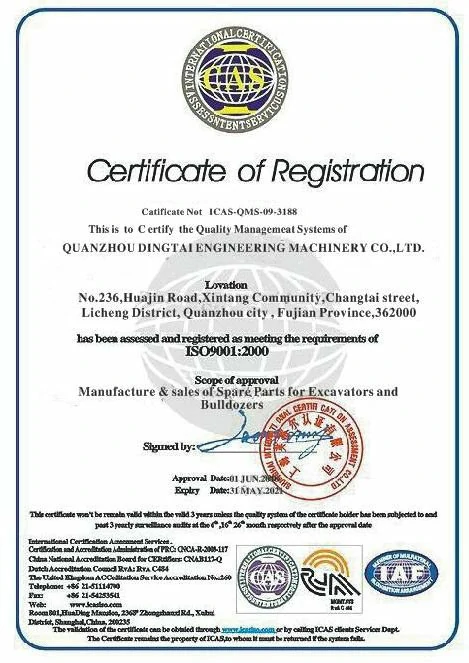
  • Certificate Details: Verify records include the equipment's serial number, the calibration date, the next calibration due date, and the standards used.
  • Consistency Check: Ensure serial numbers on the physical equipment match the certificate details. You can also look for a calibration sticker on the equipment itself.
  • Accredited Calibration: Certificates should come from an accredited provider, and the report should detail the "as found" and "as left" measurements to show any adjustments made.

Record importance

Element Details Required Assurance
Certificate Info Serial #, date, validity, standards Verification & traceability
Traceability Accreditation logo (e.g., ISO 17025) 1 Quality compliance

How often should critical equipment like calipers, micrometers, and hardness testers be calibrated?

Calibration frequency impacts equipment reliability and data precision.

Critical equipment should generally be calibrated every 3 to 12 months, depending on usage intensity and manufacturer recommendations.

Control panel in spacious industrial facility

Calibration frequency specifics

  • Usage-based Scheduling: High-use equipment (e.g., used daily in a harsh environment) needs more frequent checks, potentially every 3-6 months.
  • Standard Intervals: For most equipment under normal use, a 12-month calibration cycle 2 is a common industry standard.
  • Internal Checks: In addition to formal calibration, ask if they perform regular internal verification checks (e.g., using a certified gauge block) to catch equipment drift between cycles.

Calibration cycle

Equipment Typical Frequency Rationale
Calipers/Micrometers 6-12 months Precision assurance
Hardness Testers 12 months (with daily verification) Consistent measurements

Are their calibrations traceable to a national or international standard?

Traceability ensures compliance with recognized metrology benchmarks.

Calibrations should be traceable to a recognized national or international standard, such as those maintained by NIST (in the U.S.) or an equivalent national metrology institute. The calibration lab itself should be accredited to ISO/IEC 17025 3.

Technician using machinery in bright workspace

Traceability verification

  • Standard Conformity: The calibration certificate should explicitly state its traceability to a national standard.
  • Accreditation: The certificate should bear the logo of the accrediting body 4 (like A2LA, UKAS, etc.) that audited the calibration lab.
  • Unbroken Chain: This proves the measurement has been compared against a reference in an unbroken chain of comparisons 5, ensuring global recognition and accuracy.

Standards traceability

Aspect Verification Outcome
ISO/IEC 17025 Lab accreditation International compliance
National Standards Statement on certificate Reliability confirmation

What is the risk to my product's quality if their equipment is not properly calibrated?

Improper calibration can significantly impact product quality.

Incorrectly calibrated equipment leads to inaccurate measurement data 6, resulting in parts that do not meet specifications. This can cause improper fitment 7, incorrect hardness (leading to premature wear 8 or brittle failure), and compromised performance.

Engineer operating machinery with digital calibration display

Risks involved

  • Data Inaccuracy: A hardness tester that reads high may result in parts that are actually too soft and will wear out quickly. A caliper that reads small may result in parts that are too large and won't assemble correctly.
  • Product Reliability: Inconsistent quality 9 from batch to batch because the measurement baseline is always drifting.
  • Safety and Failures: Parts that are too brittle (from incorrect heat treatment data) can crack, and parts that are too soft can deform, both leading to catastrophic equipment failure 10.

Quality risks

Factor Risk Impact
Inaccurate Data Measurement errors Subpar quality, poor fit
Product Reliability Inconsistency, defects Premature failure, downtime

Conclusion

Verifying calibration practices is crucial to ensuring the factory delivers high-quality undercarriage parts for excavators, reducing the risk of defects and maintaining confidence in product integrity.


Footnotes  

1. Learn about ISO 17025 accreditation and what it means for calibration. ↩︎  
2. Guide to standard calibration intervals for manufacturing equipment. ↩︎  
3. Explanation of the ISO/IEC 17025 standard for testing and calibration laboratories. ↩︎  
4. List of internationally recognized calibration accreditation bodies. ↩︎  
5. What is metrological traceability and the unbroken chain of comparisons? ↩︎s
6. The top risks associated with using uncalibrated test equipment. ↩︎  
7. How dimensional inaccuracy leads to component fitment issues. ↩︎  
8. The link between incorrect hardness testing and premature part wear. ↩︎s
9. Causes of batch-to-batch inconsistency in manufacturing. ↩︎  
10. Analysis of component failures in heavy machinery due to quality defects. ↩︎

Free Quote & Information Request

Leave your inquiry, we will provide you with quality products and services!

Excavator & Bulldozer Undercarriage Parts Expert - Quality Track Roller, Carrier Roller, Sprocket Wheel
Privacy Overview

This website uses cookies so that we can provide you with the best user experience possible. Cookie information is stored in your browser and performs functions such as recognising you when you return to our website and helping our team to understand which sections of the website you find most interesting and useful.